How a Relocating Buyer Found the Right Home in Raleigh's Village District: A Real Estate Success Story
A Real Client Case Study on Finding the Right Location, Exploring Townhomes and Condos, and Negotiating a Home Purchase With Confidence
Relocating to a new city brings plenty of opportunities, but finding the right place to call home can be one of the most challenging parts of the transition. Even after arriving in Raleigh, North Carolina, understanding its neighborhoods, comparing different property types, and deciding where to purchase can take time.
For one buyer who relocated to Raleigh from North Carolina's coast, the process began with renting while exploring different areas of the city. The buyer wanted to become more familiar with Raleigh before committing to a home purchase, particularly when it came to identifying the right location and type of property.
With guidance from Casey House, Realtor, the buyer explored several townhomes and condominiums in different parts of Raleigh. As the search progressed, their preferences became clearer, allowing them to narrow down the possibilities and focus on properties that better matched their priorities.
Ultimately, the right opportunity was a home that had been on the market for some time. With Casey's guidance and negotiation efforts, the buyer secured a deal they felt comfortable with and found a home they absolutely loved in their ideal location.
This case study highlights how patience, local market knowledge, responsive communication, and a thoughtful home search can help relocating buyers navigate the Raleigh real estate market.
The Client's Situation: Relocating to Raleigh and Renting Before Buying
Moving to a new city often means making several important decisions at once.
You need to become familiar with the surrounding area, understand your daily commute, discover nearby conveniences, and determine which neighborhood best supports your lifestyle.
For this particular buyer, the transition to Raleigh began with renting.
Rather than purchasing immediately after relocating from the coast, the buyer chose to spend time experiencing the city and exploring potential neighborhoods.
This was a practical starting point because knowing a city as a visitor can be very different from understanding it as a future homeowner.
A neighborhood that looks appealing online may feel different when you experience its surroundings, visit properties, and consider how the location would fit into your daily routine.
The buyer wanted to be more certain about two important things:
- Location: Which part of Raleigh would be the right place to purchase?
- Property type: Would a townhome or condominium better meet their preferences?
These questions shaped the home search.
Instead of beginning with a narrowly defined list of requirements, the buyer needed an opportunity to explore different possibilities and understand the differences between available properties.
Casey House, Realtor, helped guide that process.
The Challenge: Narrowing Down the Right Location and Property Type
One of the biggest challenges for people relocating to Raleigh is deciding where to focus their home search.
Raleigh offers a variety of residential environments, from established neighborhoods and condominium communities to townhome developments and traditional single-family homes.
Each area has its own characteristics, and the right choice depends on the buyer's individual priorities.
For this client, the search involved identifying a more specific location while also determining which type of home would be the best fit.
Finding the Right Raleigh Neighborhood
Raleigh is made up of numerous neighborhoods, each offering different character, property options and nearby amenities.
The buyer needed to become more familiar with these differences before narrowing down the search.
One of the areas relevant to this case study is Inside the Beltline's Village District.
Located near Downtown Raleigh, Village District is a longstanding shopping, dining, and community destination that has been part of Raleigh since 1949.
According to Visit Raleigh's Village District guide, the district spans six city blocks and features more than 100 shops, cafés, restaurants, and services.
Its combination of local businesses, national retailers, restaurants, and everyday conveniences makes it an area worth exploring for buyers interested in being near a variety of destinations.
The official Village District website also provides information about its businesses, shopping directory, and events.
However, purchasing a home near a particular destination requires more than liking the surrounding businesses.
Buyers should consider the specific property, its location, transportation requirements, parking, ownership costs, and how the surrounding environment aligns with their preferences.
This is why exploring different Raleigh areas can be so valuable before committing to a purchase.
Deciding Between a Townhome and a Condominium
Another challenge was identifying the right property type.
Townhomes and condominiums can offer different ownership structures, maintenance responsibilities, layouts, and shared amenities.
For someone purchasing in a new city, understanding these differences is especially important.
A condominium typically involves ownership of an individual unit along with shared ownership or responsibilities associated with common elements, depending on the community's legal structure.
A townhome, meanwhile, describes a style of housing, but the actual ownership arrangement can vary. Some townhomes are part of condominium associations, while others involve ownership of the individual structure and the underlying land.
The physical appearance of a property does not always tell you everything about its legal ownership or maintenance obligations.
Buyers should review the governing documents, association information, insurance arrangements, maintenance responsibilities, and applicable fees before making a decision.
For this client, viewing different townhomes and condos provided an opportunity to understand which property type better matched their expectations.
The Strategy: Explore Different Areas Before Narrowing the Search
Casey's strategy was to help the buyer explore several townhomes and condominiums across different Raleigh locations.
Rather than rushing into a purchase or limiting the search too early, they looked at multiple options.
This approach allowed the buyer to develop a clearer understanding of the available properties and refine their criteria.
It also gave Casey an opportunity to learn more about what the buyer valued most.
1. Comparing Properties in Different Areas
The initial search included townhomes and condominiums in several Raleigh locations.
Seeing properties in different areas helped the buyer evaluate more than just the homes themselves.
Location, surrounding conveniences, property layouts, and the overall environment all became part of the comparison.
This is particularly important when relocating because buyers may not yet have enough firsthand experience to know which areas they prefer.
Online listings can provide useful information, but visiting properties offers another level of perspective.
Buyers can compare how homes are arranged, consider their surroundings, and evaluate whether a particular location feels practical for their needs.
2. Understanding Property Preferences
As the buyer explored different options, the search became more focused.
They were no longer simply looking at available homes. They were learning which features and property characteristics mattered most.
This is a valuable stage in the home-buying process.
Some buyers begin with a preference for a condominium but discover that a townhome better matches their expectations.
Others may initially focus on a particular neighborhood before realizing that another nearby location offers a better combination of property features and convenience.
There is no universal formula for choosing between these options.
The right decision depends on the buyer's budget, preferred layout, ownership responsibilities, location priorities, and long-term plans.
By viewing different properties, this buyer gained a clearer understanding of what they wanted.
3. Narrowing Down the Search Criteria
Once the buyer had explored several properties, the search criteria became more defined.
This made the next stage more productive because both the buyer and Casey had a better understanding of what to prioritize.
Instead of continuing to consider every available townhome or condominium, they could concentrate on properties that more closely matched the buyer's preferences.
This demonstrates why a flexible approach at the beginning can be beneficial.
Starting with an open mind does not mean the search has to remain broad indefinitely. Exploration can help buyers establish a more specific direction.
For people relocating to Raleigh, this can make the difference between an overwhelming property search and a more organized process.
The Turning Point: Finding an Opportunity That Had Been on the Market for a While
After exploring different Raleigh properties and refining the search criteria, the buyer found an opportunity that aligned with their preferences.
Interestingly, the home had already been on the market for some time.
For buyers, properties that have been listed longer than expected can sometimes present opportunities worth investigating.
However, an extended listing period does not automatically mean a property is overpriced, defective, or a bargain.
There can be many reasons a property remains available, including pricing, presentation, buyer preferences, property characteristics, financing considerations, or changing market conditions.
The important thing is to understand the individual property's circumstances.
In this case, Casey helped the buyer approach the opportunity thoughtfully and negotiate a deal that the buyer felt good about.
Why a Longer Listing Period Can Be Worth Investigating
When a property has been available for an extended period, buyers may have an opportunity to evaluate its pricing and circumstances more closely.
Before submitting an offer, it can be helpful to investigate:
- The property's original asking price and any subsequent price changes.
- Comparable properties that have recently sold.
- How similar properties are currently priced.
- Whether the property has been under contract previously.
- The property's condition and any inspection concerns.
- The seller's circumstances, when information is available and appropriately communicated.
- The terms and conditions that may be negotiated.
A property's time on the market is only one piece of information.
Buyers should avoid assuming that every longer-listed property represents an opportunity for a significant discount.
Instead, they should evaluate the available evidence and determine whether the asking price and proposed terms make sense for their situation.
Understanding Negotiation Beyond the Purchase Price
Negotiating a home purchase involves more than offering an amount below the asking price.
Other contract terms can influence the overall transaction, including:
- Proposed closing date.
- Due diligence period.
- Earnest money and due diligence fee arrangements.
- Financing and appraisal-related considerations.
- Repair requests, where applicable.
- Personal property included in the transaction.
- Other negotiated terms and deadlines.
In North Carolina, buyers should understand the state's due diligence process and how the purchase contract addresses their responsibilities.
The North Carolina Real Estate Commission's Due Diligence Questions and Answers explains the buyer's opportunity to investigate a property and transaction during the agreed due diligence period.
The buyer may need to arrange inspections, review title information, investigate financing, obtain a survey, and consider other property-related matters.
The appropriate terms depend on the particular transaction.
For this client, the outcome was a negotiated agreement they felt comfortable accepting, allowing them to move forward with a property they genuinely loved.
Why Local Knowledge Matters When Buying a Home in Raleigh
Relocating buyers often face a challenge that longtime residents may not experience to the same extent: they are learning the real estate market and the city at the same time.
They may not know which neighborhoods offer the property types they prefer, how different locations compare, or what to investigate before making an offer.
This is where local real estate knowledge becomes valuable.
Understanding Village District and Its Surroundings
Village District is one of Raleigh's established shopping and dining destinations Inside the Beltline.
Its history dates back to 1949, when it opened as Cameron Village. The name changed to Village District in 2021.
The Encyclopedia of North Carolina's history of Cameron Village provides additional historical context about the development and its role in Raleigh.
Today, Village District offers a mix of shops, restaurants, cafés, and services.
For buyers considering properties in and around the district, it is helpful to explore the surrounding residential streets and understand the differences between individual locations.
Proximity to a retail and dining destination does not necessarily mean every nearby property offers the same access, parking arrangements, or daily experience.
Buyers should evaluate the actual address and consider how they would use the surrounding area.
Looking Beyond the Immediate Neighborhood
Another important consideration when relocating is understanding how the property connects to the rest of Raleigh.
Depending on the buyer's priorities, this may involve considering:
- Access to employment locations.
- Commuting routes and transportation options.
- Nearby shopping and grocery destinations.
- Restaurants and recreational facilities.
- Parking availability.
- Walking and cycling routes.
- Access to major roads and other parts of the Triangle.
Visit Raleigh's Midtown Raleigh guide offers an overview of several shopping, entertainment, and dining districts, including Village District and North Hills.
Exploring these areas can help relocating buyers become more familiar with Raleigh's different destinations before choosing where to purchase.
The Importance of Communication During a Home Purchase
One of the most prominent themes in this client's testimonial was Casey's communication.
The buyer described her as professional, prepared, patient, and consistently responsive.
They specifically appreciated that Casey followed up promptly, researched questions when she did not immediately know an answer, and provided updates throughout the transaction.
For buyers navigating an unfamiliar market, this kind of communication can be particularly important.
Prompt Follow-Up Builds Confidence
Buying a home involves many questions.
Some may relate to property features, neighborhood information, offer terms, inspection findings, or closing requirements.
When buyers are unfamiliar with the process, unanswered questions can create uncertainty.
Having a professional who follows up and helps find accurate information can make the experience more manageable.
The testimonial highlighted that when Casey did not immediately know an answer, she took the initiative to investigate and get back to the buyer.
That willingness to follow through helped establish trust throughout the process.
Listening to the Buyer's Priorities
Another important part of the testimonial was Casey's ability to listen.
The client explained that Casey paid attention to what they thought they wanted and asked thoughtful questions when they were unsure.
This is an important aspect of representing buyers.
A successful home search should not be based solely on the agent's assumptions about what a buyer needs.
It should develop through conversations, property comparisons, and a better understanding of the buyer's preferences.
As those preferences become clearer, the search can become more targeted.
Attention to Detail Throughout the Transaction
The client also praised Casey for consistently paying attention to details.
Real estate transactions involve multiple documents, deadlines, and responsibilities.
Missing an important detail can create complications or delays.
A careful buying process includes reviewing relevant documents, keeping track of contractual dates, communicating about outstanding items, and helping clients understand the next steps.
The client described Casey as someone who dotted every "i" and crossed every "t."
That feedback reinforces the importance of preparation and consistent follow-through when purchasing a home.
The Result: A Home the Buyer Loves in the Ideal Location
After exploring several townhomes and condominiums across Raleigh, the buyer had developed a clearer understanding of the location and property type they wanted.
The search eventually led to a home that had been on the market for some time.
With Casey's assistance, the buyer negotiated a deal they felt good about and secured a home they absolutely loved in their ideal location.
This outcome illustrates two important lessons.
First, exploring different options can help buyers identify their priorities.
Second, patience and a thoughtful negotiation strategy can help buyers recognize opportunities that might otherwise be overlooked.
The most meaningful part of this experience was not simply finding a property.
It was finding a home that matched the buyer's preferences while feeling comfortable with the purchase agreement.
The client summarized the experience with a strong recommendation:
"Her knowledge of what is available where, was key to my home purchase and I could not be more pleased."
The testimonial also emphasized Casey's professionalism, low-pressure approach, patience, and consistent communication.
For a buyer navigating an unfamiliar city, those qualities made a meaningful difference.
What Relocating Buyers Can Learn From This Raleigh Homebuying Experience
Every relocation and home search is different. However, this case study offers several practical lessons for anyone planning to purchase a home in Raleigh.
1. Renting First Can Help You Learn the City
Some relocating buyers prefer to rent before purchasing.
This can provide an opportunity to become familiar with different areas, commuting patterns, and everyday destinations.
It can also help buyers determine which neighborhoods they want to prioritize.
Renting first is not necessarily the right approach for everyone, since financial circumstances, timing, and individual preferences vary.
However, taking time to understand a new city can help make a later purchase more informed.
2. Do Not Limit Your Search Too Early
If you are unfamiliar with Raleigh, consider exploring multiple neighborhoods before making a final decision.
You may initially have a preferred location but discover other areas that better match your requirements.
A broader search can also help you understand differences in property prices, layouts, ownership arrangements, and surrounding amenities.
3. Compare Townhomes and Condominiums Carefully
Before choosing between a townhome and a condominium, understand the ownership structure and responsibilities associated with each property.
Review:
- Homeowners association fees.
- What the association maintains.
- Insurance responsibilities.
- Shared amenities and common areas.
- Rules and restrictions.
- Reserve funding and available financial information.
- Any pending or anticipated special assessments.
Do not assume that two properties with similar appearances have identical ownership arrangements or costs.
Request the relevant association documents and review them carefully during the appropriate transaction period.
4. Understand the Buyer's Due Diligence Responsibilities
North Carolina has a distinct due diligence framework.
Buyers should understand the terms of their purchase contract and the time available to investigate the property and transaction.
The North Carolina Real Estate Commission's buyer due diligence resource provides information about the importance of reviewing documents, asking questions, and ordering appropriate inspections.
Consider the following during the process:
- Schedule appropriate property inspections.
- Review available property disclosures.
- Investigate title and survey matters.
- Confirm financing requirements.
- Understand the contractual deadlines.
- Ask qualified professionals about concerns that require specialized advice.
The objective is to make an informed decision before proceeding with the transaction.
5. Do Not Overlook Homes That Have Been Listed for Longer
A home that has been on the market for a while may be worth considering and likely gives the buyer more negotiating power.
However, buyers should investigate why it remains available rather than assuming the seller will automatically accept a lower offer.
Review comparable sales, property condition, pricing history, and the seller's available terms.
A well-supported offer should reflect the property's circumstances and the buyer's financial comfort.
6. Choose an Agent Who Listens and Communicates
Your relationship with your buyer's agent can influence how comfortable you feel throughout the process.
Look for someone who takes time to understand your preferences, answers questions, communicates consistently, and explains unfamiliar parts of the transaction.
You should also understand the terms of your buyer representation agreement, including the services being provided and compensation arrangements.
The right professional relationship should support informed decision-making rather than create pressure.
How Casey House, Realtor, Helps Relocating Buyers Navigate Raleigh Real Estate
Choosing a home in a new city requires more than access to property listings.
Buyers need to understand the local market, compare neighborhoods, evaluate different property types, and make decisions that align with their personal priorities.
Casey House, Realtor, brings a client-focused approach to helping buyers navigate these decisions.
This client's experience highlights several aspects of her professional approach.
A Low-Pressure Approach to Homebuying
The buyer first met Casey informally at an open house.
What encouraged the buyer to work with her was her low-pressure approach, professionalism, preparation, and willingness to answer questions.
This is an important distinction for buyers who are still exploring their options.
Not everyone is ready to purchase immediately, especially when relocating to an unfamiliar city.
Having the opportunity to ask questions, explore different properties, and establish priorities without feeling rushed can make the process more comfortable.
In-Depth Knowledge of Raleigh's Residential Areas
One of the strongest points in the testimonial was Casey's knowledge of what was available in different locations.
For relocating buyers, understanding the relationship between neighborhoods and property types can be valuable.
A buyer may have a particular location in mind but not know which types of homes are commonly available there.
Casey's work with this client involved exploring multiple townhomes and condominiums across different Raleigh areas before narrowing the search.
This demonstrates the value of understanding the buyer's priorities and helping them evaluate opportunities across the market.
Consistent Communication and Follow-Through
The client repeatedly highlighted Casey's communication throughout the transaction.
Her prompt follow-up, willingness to find answers, and consistent updates helped the buyer stay informed.
Real estate transactions can involve unfamiliar documents, important deadlines, and decisions that require timely attention.
A professional who prioritizes communication can help buyers understand what is happening and what they need to consider next.
Patient Guidance and Attention to Detail
The testimonial also emphasized Casey's patience when answering questions and explaining the buying process.
For someone purchasing in a new city, this kind of guidance can be particularly valuable.
It helps buyers move from uncertainty toward a clearer understanding of their options.
Casey's attention to detail and preparation were also important parts of the client's experience, from the initial search through the purchase.
Negotiation With the Buyer's Priorities in Mind
The eventual property had been listed for some time, creating an opportunity for the buyer to negotiate an agreement they felt comfortable with.
The client's satisfaction with the negotiated deal reflects the importance of understanding a property's circumstances and approaching negotiations thoughtfully.
Every transaction is different, and no negotiation outcome can be guaranteed.
However, preparation, local knowledge, and understanding the buyer's priorities can help guide the decision-making process.
For relocating buyers considering Raleigh, Casey's approach emphasizes finding the right fit rather than simply moving through listings as quickly as possible.
Client's Testimonial
"Casey House made my seemingly daunting city home search/purchase better than I could have imagined. She said she was a low pressure realtor when I informally met her at an open house. This and her professionalism, preparedness and patience in answering my questions on purchasing in the city encouraged me to contract with her. This cheerful attention continued without fail during the entire process. Casey dotted every "i" and crossed all "t's". She hustles 24/7 for her clients! ALWAYS a prompt follow up to my questions. If she didn't know the answer (rare) she ran it down and got back to me the same day. Tremendously consistent, spot on communication beginning to end. She listens to what you think you want and asks kind questions if you are not sure. I truly appreciated her professional in-depth knowledge of this area. I was seeking a niche type property in a particular location. Her knowledge of what is available where, was key to my home purchase and I could not be more pleased. I highly recommend Casey and would work with her again! "
Frequently Asked Questions About Buying a Home in Raleigh After Relocating
1. Should I rent before buying a home in Raleigh?
Renting before purchasing can give you time to become familiar with Raleigh's neighborhoods, commuting routes, and available property types.
It may be helpful if you are uncertain about where you want to live.
However, whether renting first makes sense depends on your finances, timeline, and individual circumstances.
2. What should I consider when buying a home in Village District Raleigh?
Consider the property's specific location, purchase price, layout, ownership structure, maintenance responsibilities, parking, and proximity to the destinations you regularly visit.
Village District offers a mix of shops, restaurants, cafés, and services, but each nearby property should be evaluated individually.
3. Is a townhome or condominium better for a relocating buyer?
Neither property type is automatically better.
Townhomes and condominiums can differ in ownership structure, maintenance obligations, association fees, insurance, and available amenities.
Review the specific property's documents and costs before deciding.
4. Can I negotiate on a Raleigh home that has been on the market for a long time?
Potentially, yes.
A longer listing period may provide an opportunity to investigate the seller's position and evaluate whether the asking price is supported by comparable sales.
However, the length of time a property has been listed does not guarantee that the seller will accept a lower offer.
Your offer should reflect the property's condition, market evidence, and your financial priorities.
5. What is due diligence when buying a home in North Carolina?
Due diligence is the period agreed upon in the purchase contract during which the buyer investigates the property and transaction.
This may include inspections, surveys, title searches, financing, and other investigations.
Buyers should understand their contractual obligations, fees, and deadlines before signing.
6. How can I find the right neighborhood when moving to Raleigh?
Start by identifying your general priorities, such as commute, property type, budget, nearby destinations, and preferred surroundings.
Explore several areas and visit properties in person.
Working with a Raleigh buyer's agent who understands different residential locations can help you compare available options.
7. Why should relocating buyers work with a local Raleigh real estate agent?
A local real estate professional can help buyers understand neighborhood differences, identify relevant property opportunities, evaluate comparable sales, prepare offers, and navigate transaction requirements.
For someone unfamiliar with the city, this guidance can make the process easier to understand.
Final Thoughts: Finding the Right Raleigh Home Takes More Than Finding the Right Listing
Relocating to Raleigh and deciding where to purchase a home can take time.
The experience of this buyer demonstrates why exploring different neighborhoods, comparing property types, and working with a knowledgeable real estate professional can make a difference.
The buyer began by renting and becoming familiar with Raleigh after moving from the coast.
With Casey House, Realtor, they explored several townhomes and condominiums, refined their preferences, and eventually identified a property that matched their desired location and home requirements.
The fact that the property had been on the market for some time became an opportunity to negotiate an agreement the buyer felt good about.
Most importantly, the buyer found a home they absolutely loved.
For anyone planning to relocate to Raleigh, the takeaway is simple: you do not have to know exactly where you want to live before beginning your search.
Give yourself the opportunity to explore, ask questions, compare properties, and understand the market.
With thoughtful guidance and a clear understanding of your priorities, you can approach the home-buying process with greater confidence.
Planning to relocate to Raleigh or purchase a home near Village District?
Casey House, Realtor, can help you explore Raleigh's residential areas, compare townhomes and condominiums, understand available opportunities, and navigate the buying process.
Whether you are moving from another part of North Carolina or relocating from out of state, Casey can help you take the next step toward finding a home that fits your priorities.
Contact Casey House, Realtor
Email: [email protected]
Phone: 919-335-3620
Website: https://caseyhouserealtor.com/
The right home is not simply about finding a property. It is about finding the right fit for where you want to live.
Sources and Further Reading
- Village District – Official Website
- Visit Raleigh – Village District Overview
- Visit Raleigh – Midtown Raleigh Guide
- NCpedia – History of Cameron Village / Village District
- North Carolina Real Estate Commission – Due Diligence Questions and Answers
- North Carolina Real Estate Commission – Questions and Answers on Due Diligence for Residential Buyers
- Consumer Financial Protection Bureau – Buying a Home
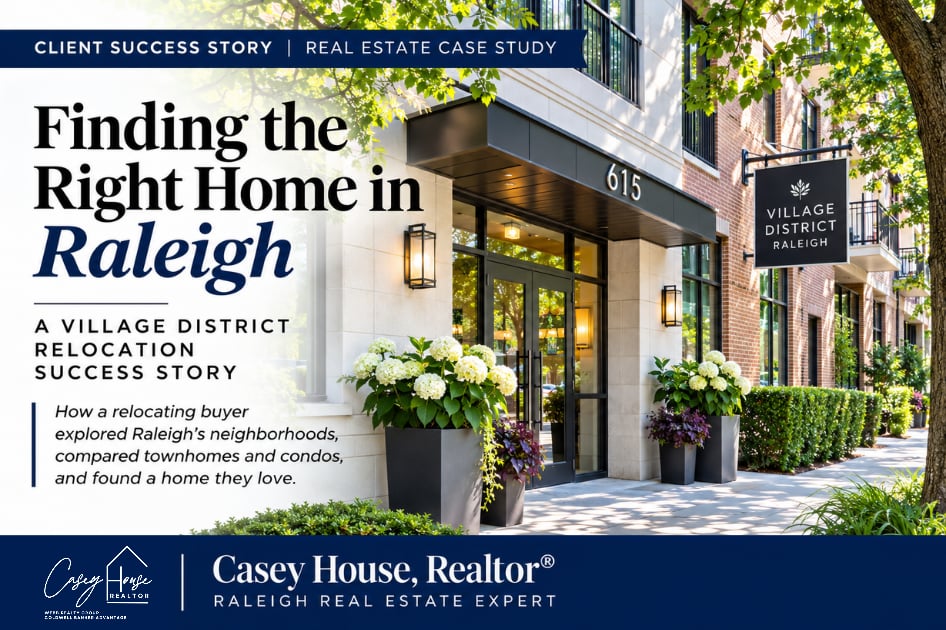
Editorial note: This article is based on the client testimonial and transaction information supplied for publication. The buyer's identity is not disclosed. The supplied cover-photo reference is 615 Daniels St #215, Raleigh, NC. Confirm the property's relationship to the completed transaction and obtain permission to use its photograph before publication. No purchase price, closing date, discount amount, or unprovided property specifications have been added.